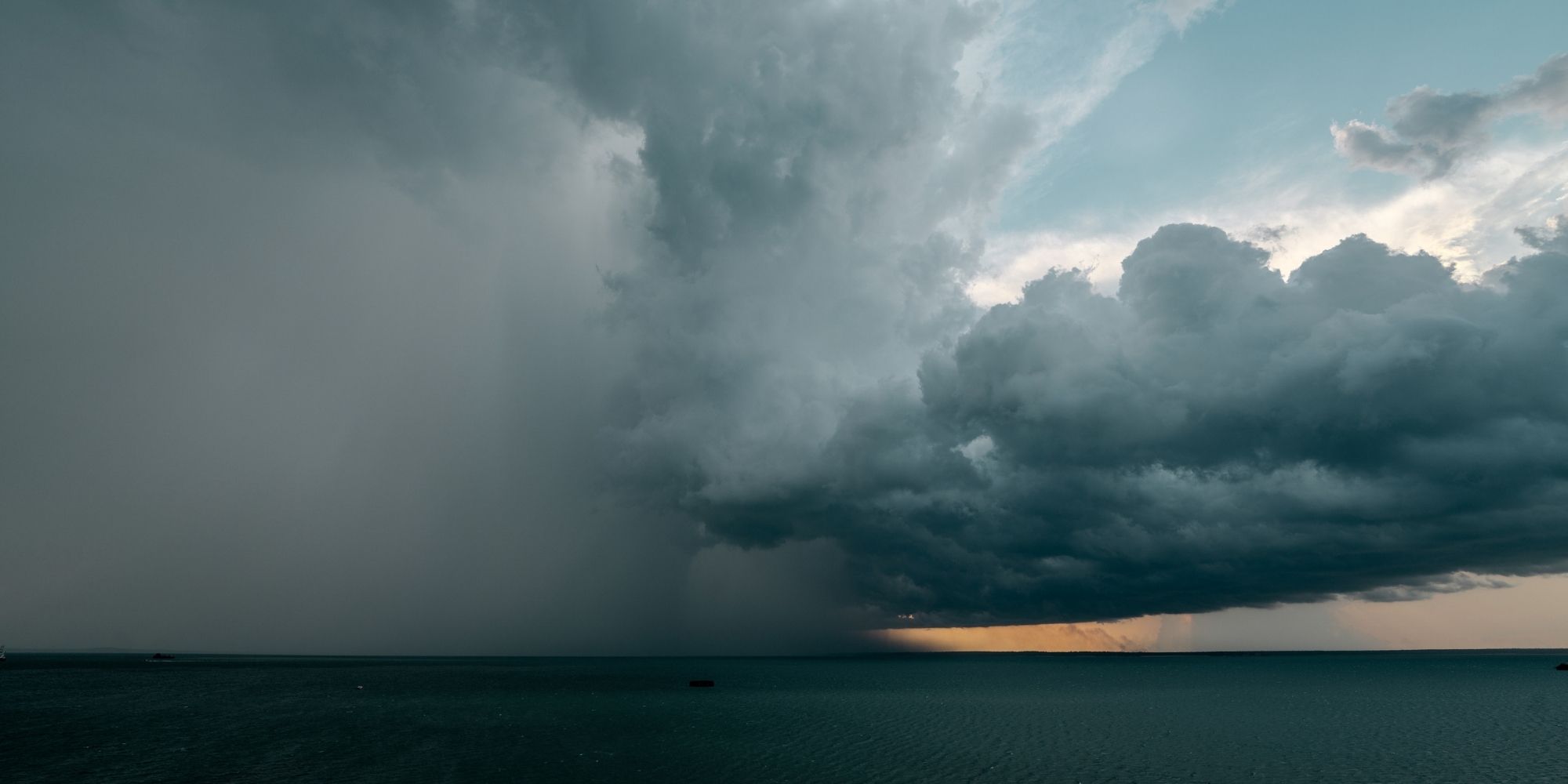
Predicting the future with confidence (intervals).
Most of us care about confidence when checking the weather, especially if rain might ruin a picnic or soccer practice. But when business operations are on the line, confidence isn’t just nice to have, it’s a factor that can directly affect the bottom line. Should you plow the fields or wait it out? Will rain delay critical shipments on your planned route? Is it safe to keep roofing crews on the job? You get the point: “maybe” just doesn’t cut it.
Forecasting rain: More than meets the eye
So, what’s really happening behind the scenes when a weather model predicts rain? Traditional physics-based models use the laws of nature to forecast future weather conditions. Think of it like predicting what happens to an apple when it falls from a tree. A good prediction can be based on physics - our knowledge about how the world works, written down in equations. Newton figured out the mathematics needed to explain the behavior of a falling apple in the 1600s. Since then, we have also figured out the mathematics needed to explain weather, which is the basis for modern weather forecasting.
Machine learning (ML) models, on the other hand, learn from history. They analyze millions of past weather patterns to recognize what is likely to happen next. At Xweather, we run both of these methods side-by-side. When it comes to short-term rain prediction, the ML models consistently outperform traditional physics-based forecasts. And yet, while AI is generally great at predicting what will happen, it has historically struggled with the certainty of predictions. A forecast of 30% chance of rain was often just an estimate – until now.
When you ask, “Will it rain three hours from now?” our deep neural networks get to work, fusing real-time satellite, radar, and other data sources to get you the answer. But we didn’t stop there. We recently tackled a known challenge in the field, wrote a research paper on it, and presented it to the weather science community. Though our forecast engine is state-of-the-art, the unpredictability of weather challenges even the best methods. This latest research tames that uncertainty. While AI is great at predicting what will happen, it has historically struggled to express exactly how sure it is. A forecast of 30% chance of rain was often just a best estimate, not much better than “probably it won’t rain”. Thanks to our latest research, we have aligned the model's confidence with reality: a forecast of 30% chance of rain means that in that type of weather situation, it will rain three times out of ten.
Best guess is not good enough
What does this mean to you? In technical terms, the ML-powered probability of precipitation you get from Vaisala Xweather is accurately calibrated. In plain English, we don’t just answer “Will it rain?” but we can also answer “How confident are you that it will rain?”
Why do most neural networks struggle with this? Calibration has been overlooked because, in many AI tasks, the exact probabilities are not important. In image recognition, for example, the model will produce likelihoods of the image depicting a cat (70%), a dog (60%), or a traffic light (2%). As long as the cat gets the highest score for an image of a cat, it suffices – it doesn’t really matter if the score was 70% or 90%. But with rain forecasts, every percentage point matters. If we say there’s a 30% chance of rain, we want that number to reflect reality.
This work also benefits confidence intervals; The best-case and worst-case scenarios. Instead of just a single number, we can give you a reliable range. We can tell you, "It will likely snow this much, but it definitely won't exceed this amount. This helps you set safety buffers that are safe without being wasteful.
Stay confident!